%20(1).png)

.png)
The Communication Challenge Facing Business Schools
Today's prospective students receive an overwhelming amount of information throughout the recruitment journey.
Offer holders receive emails about enrollment, accommodation, visas, careers, events, scholarships, orientation, and student life. Yet despite this, universities continue to face declining engagement rates, unanswered questions, and students who remain uncertain about their decision.
The challenge is rarely a lack of communication.
The challenge is ensuring students see the information, engage with it, and receive support that is relevant to their specific needs.
Traditional communication channels remain important, but many institutions are experiencing declining email engagement and increasing competition for student attention. As candidate journeys become more complex, business schools are looking for new ways to create meaningful engagement before students arrive on campus.
Moving Beyond One-Size-Fits-All Communication
This is where targeted communication becomes valuable.
Instead of sending a single message to every student, universities can create communications designed for specific audiences.
Examples include:
- Students asking questions about accommodation
- International students preparing for arrival
- MBA candidates interested in networking opportunities
- Students expressing concerns about finances
- Highly engaged students interested in ambassador roles
- Students attending upcoming recruitment events
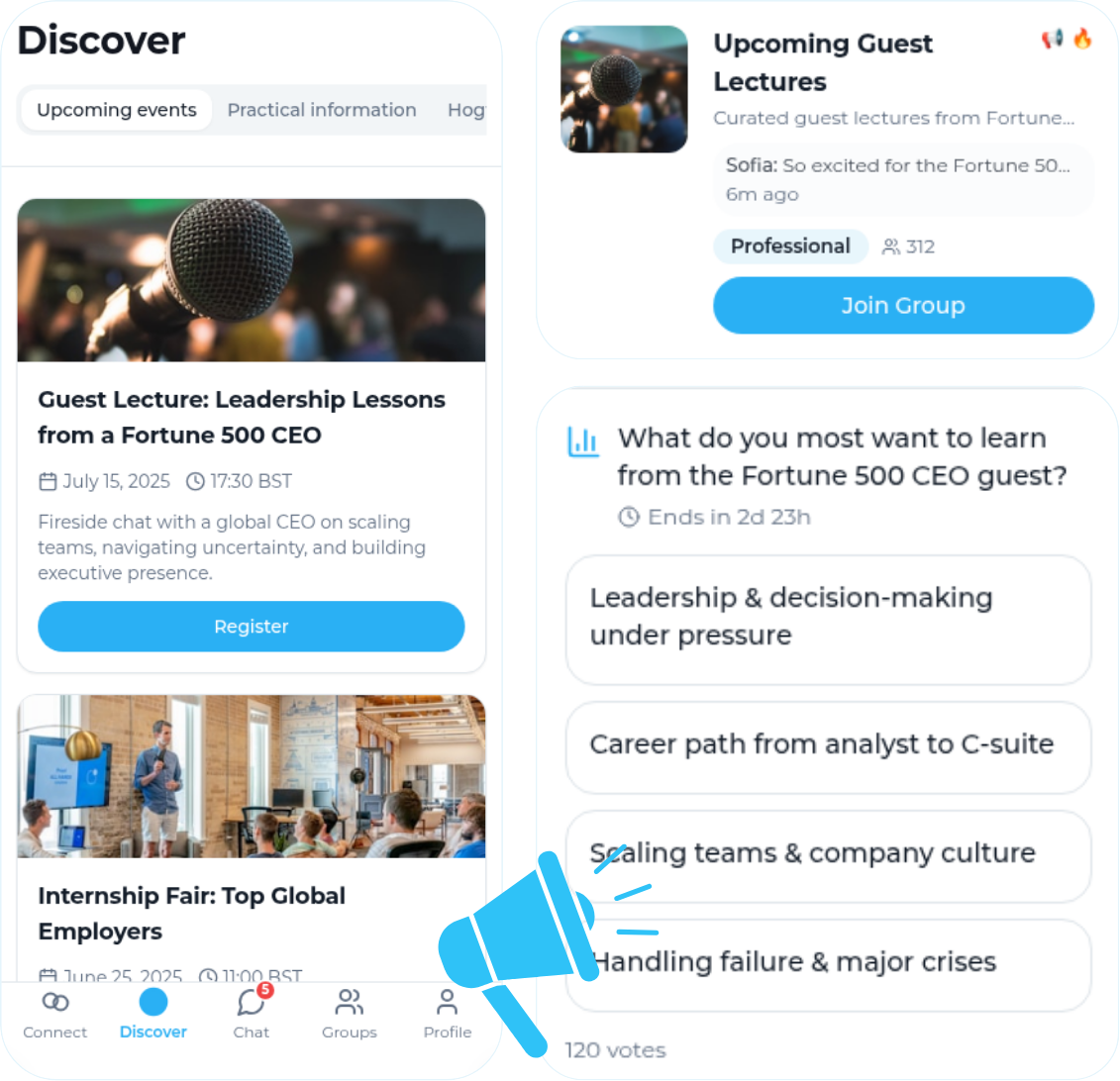
The objective is not to send more messages but to send more relevant messages to the right offerholders at the right time.
Using Community Insights to Deliver Relevant Support
Within Goin, institutions can identify groups of students based on engagement patterns, community discussions, sentiment indicators, and behavioural insights.
This allows teams to better understand what students are talking about and what support they may require.
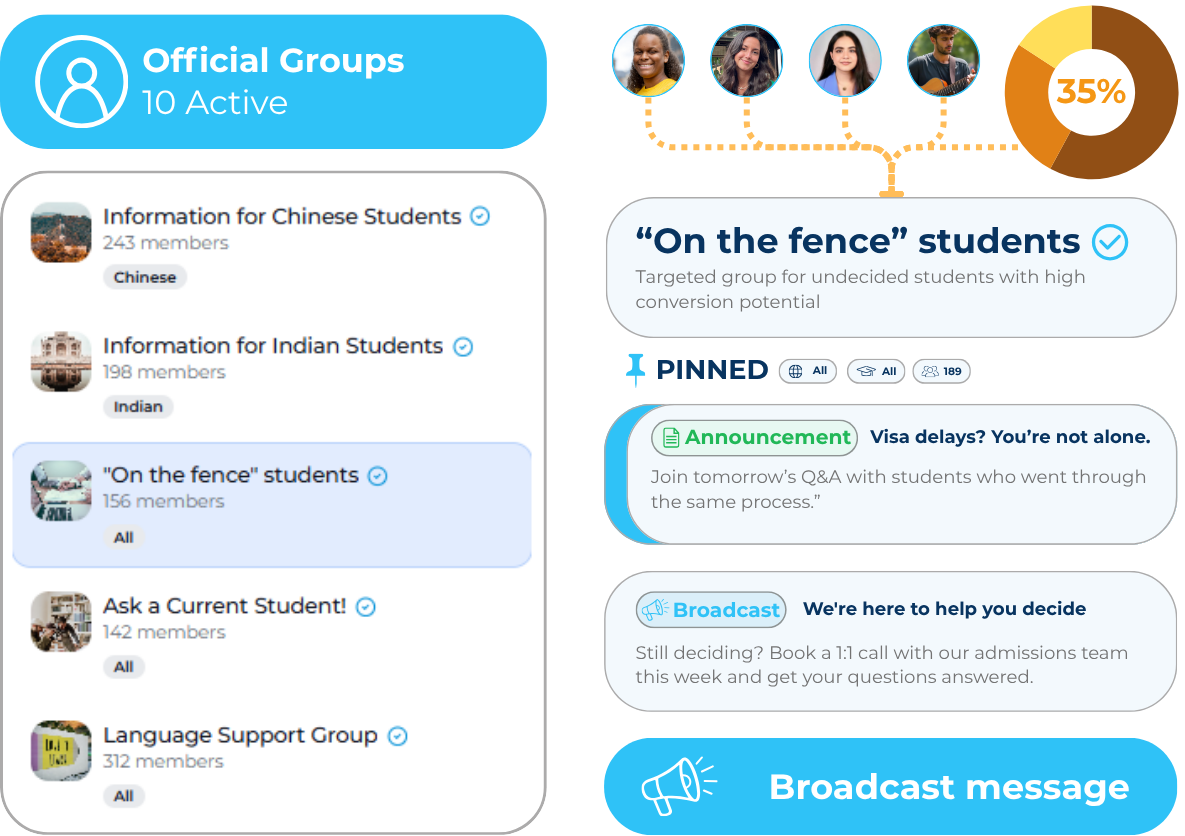
For example:
Loughborough Business School actively uses these channels to promote and host student-focused sessions, including web chats on topics such as international student experiences and application-related support.
These sessions are promoted directly within the community, allowing students to discover relevant opportunities while already engaging with peers and university representatives.
For business schools, this creates opportunities to support activities such as:
- MBA networking sessions
- Career development workshops
- Employer engagement events
- Scholarship information sessions
- Visa and relocation webinars
- Alumni panels and Q&A sessions
Oulu Business School also demonstrates another important aspect of community-based communication.
Within their community, students have access to both official university communication and ambassador-led support.
The Ask UniOulu Ambassador channel allows ambassadors to answer questions, share experiences, and provide practical guidance based on their own student journey.
Alongside this, the Official Noticeboard enables staff to communicate important updates and information through a dedicated university channel.
Together, these spaces create a balance between official guidance and authentic student perspectives.
Students receive trusted information while also benefiting from the reassurance and practical advice that often comes from speaking with someone who has already experienced the transition themselves.
What This Could Look Like in Practice
Imagine a business school identifying groups of students based on their interests, questions, engagement patterns, or stage in the decision-making process.
Students interested in career outcomes could receive invitations to employer networking events.
Students exploring scholarship options could be directed toward funding information and financial guidance.
International students preparing to relocate could receive targeted support around visas, accommodation, and arrival planning.
Highly engaged students could be invited to ambassador programmes, networking opportunities, or community leadership initiatives.
Rather than increasing communication volume, institutions increase communication relevance.
The result is a more personalised experience that helps students access the support most relevant to their individual journey.
.png)
Building Stronger Candidate Experiences Before Enrollment
The most successful business schools are no longer focused solely on sending information.
They are focused on creating environments where students can engage with that information, ask questions, connect with others, and access support when they need it.
Examples from institutions such as Loughborough University and the University of Oulu demonstrate how dedicated communication channels can strengthen engagement and create more connected candidate experiences.
As business schools continue to compete for student attention and enrollment, the next evolution is not simply communicating more.
It is communicating more meaningfully.
By combining community engagement, trusted information, peer support, and increasingly relevant communication, institutions can create stronger relationships with students long before they arrive on campus.
%20(1).png)
.png)
.svg)
.png)
.png)
%20(1).png)
.jpg)
.png)
.png)
.png)
%20(1).png)
.png)
.jpeg)
.png)
.jpg)
.png)
.png)
.png)

%20(1).png)
.png)
.png)
.jpg)
.png)
.png)
.png)
.jpg)
.png)
.png)
.svg%20(1).png)
.png)
.png)
%20(1).png)
.png)
.png)
%20(1).png)
.jpg)
%20(1).png)
%20(1).jpg)
%20(1).jpg)

.svg)
.png)
%20(1).png)
.png)
.jpg)
.svg)
.jpg)
.jpg)
.png)
%20(1).png)
.png)
.svg)
.jpg)
.png)

.png)

%20(1).png)
.png)
.png)
.png)
.png)
.png)


%20(2)%20(1).png)


.jpg)


.png)
.png)
.png)
.png)
.png)
.png)
.png)
