%20(1).png)

.png)
The Challenge: Yield Uncertainty in a Noisy Landscape
In student recruitment, the most critical signals often go unseen. When an admitted student ghosts your emails or silently melts away, the damage is already done. You didn’t just lose an enrollment, you lost a chance to intervene. However, that’s not all.
Today’s students are juggling competing offers, visa stress, financial decisions, and emotional readiness, all long before they set foot on campus. For recruitment teams, that means:
- Less visibility into how offer holders actually feel about enrolling
- No structured way to spot students who are on the fence or at risk of melting
- Limited bandwidth to address concerns at scale
And with growing pressure to hit regional and program-specific targets, recruitment teams are flying blind.
The Solution: Early Sentiment Analysis with the Goin’ Score
Universities are now acting on communities as an additional link to their recruitment strategies. Since students are able to connect early on, this acts as the perfect opportunity to gauge how students truly are feeling. Over 140 universities leverage Goin’ for this solution.
As students join their university’s private Goin’ Community, they’re invited to take a short in-app survey (The Goin’ Score) that is embedded early in the funnel as part of a platform they already trust and use.
The result is a data-rich, genuine pulse check on every student’s mindset, captured early and tracked over time – all found in the university’s extensive community dashboard where you can evaluate other metrics like connections, excitement and integration.
Each student is placed into one of three predictive segments:
- High Probability: Students who are excited, connected, and highly likely to enroll.
- On the Fence: Students showing uncertainty, often citing concerns like visa issues, finances, or competing offers.
- Low Probability: Students with serious doubts or obstacles—many of which are actionable if caught early.
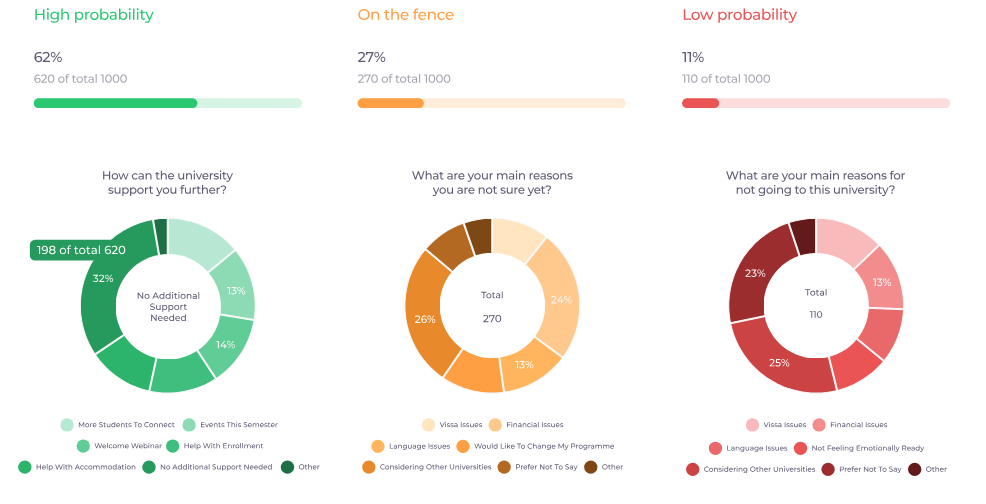
From there, the platform shows you why.
Some students cite financial concerns. Others mention visa stress, housing issues, or simply not finding the right social fit. These are the signals you can and need to act on to ensure they cross the line.
And because this is embedded in the app experience, it’s frictionless. Students aren’t being chased for feedback. They’re offering it naturally, when they’re most engaged.
Key Features Universities Rely On
What makes the Goin’ Score uniquely powerful is not just knowing who’s at risk. It’s in knowing where and why.
Break It Down by Nationality, Study Program, and Cycle
Every data point is filterable by nationality, program of study and cycle intake. That means your team can:
- Identify drop-off risk among Indian offer-holders in Engineering.
- Spot strong engagement among Dutch Business applicants.
- Compare year-on-year patterns in key recruitment regions.
This is crucial for international offices working toward geographic or program-specific targets — and for broader marketing teams trying to measure campaign performance in context.
.png)
Real-Time Segmentation for Proactive Action, Reduced Guesswork, Increased Focus
Imagine having a data table showing which Engineering students from Nigeria are at risk due to visa delays, and what kind of support they’re asking for. That’s the level of clarity universities gain with this dashboard.
Rather than reacting to melt post-factum, recruitment teams can:
- Run targeted events for students who are unsure, disengaged or “on the fence”.
- Trigger custom outreach from staff or student ambassadors to support at-risk cohorts.
- Enable Champions in the community to reach out to low-engagement peers.
- Collaborate across departments, sharing insights with housing teams, visa support, or mental health services based on what students are expressing in real time.
What Feels Out of Reach Is Often Within Your Control
It’s easy to assume that certain concerns—like finances, visa delays, or language barriers—are out of your hands. But Goin’s sentiment data makes it clear: many of these issues can be softened or even solved with the right response at the right time, seeing it early enough to act.
Examples of how universities are responding:
Financial stress?: Host a webinar on part-time work regulations, share budgeting resources, or connect students with others working locally.
Visa anxiety?: Organize timeline-based webinars, involve your visa support team, or pair students by region for peer advice.
Language concerns?: Promote free or discounted language programs, offer buddy pairings, or highlight non-academic language events.
Competing offers?: Use the data to spot where students are hesitating. Invite them to a tailored session comparing academic support, cost of living, or career outcomes at your university vs. competitors—based on what students themselves are saying.
What matters is timing. These concerns don’t have to lead to melt, unless they go unaddressed. By using the Goin’ Score and segmentation data as your early-warning system, your team can act with precision and purpose.
Want to see how it works?
Watch our CS team break down the Goin’ Dashboard, live sentiment data, and how universities are using it to boost conversion across every region and study program.
The Outcome: Yield Gains, Better ROI, and Less Workload
When universities know where to act, they stop wasting energy on guesswork and start converting smarter and reduce workload by acting sooner.
"For offer holders who maybe haven't quite decided whether or not to accept UCL's offer, we use Goin’ to get them over…You’ve already done the hard work to get them to apply. Now it’s about making sure they choose you…It’s common sense that if students are less anxious before arrival, they’re more likely to succeed academically and socially” - Neil Green, Head of International Student Recruitment at UCL
“The sentiment analysis [Goin’ Score], understanding who are the students with a positive feeling about it, and understanding those who are on the verge of saying, ‘Maybe I’m not going,’ or, ‘I’m absolutely happy, I can’t wait, I made friends,’ it is helpful,”,It’s getting us insights that we didn’t have before.” - Ilaria Bossi. Associate Director International Marketing and Recruitment at Cattolica University
“We’re excited to see how we can track who’s curious, who’s interested, and who’s really engaged. That helps us focus our energy on students who might be on the fence, and see what we can do to help them find the best fit, even if it’s not Brown. We want what’s best for them.” - Mathew Wallace, Director of Admission, Marketing and Student Engagement at Brown University
“Students need to know what they’re getting into. The cost of living, the content of the program, the academic expectations. There are always going to be unknowns when moving abroad, but if we can bring them as close to ‘super well informed’ as possible, we’ve done our job.” - Mats Engblomm Marketing Specialist at University of Helsinki
Why It Matters Now
International recruitment is only getting more competitive, and more complex. You need to know which students need your attention, which ones are ready to commit, and which regions or programs need a strategic push. Goin’s sentiment analysis gives you that intelligence, without another survey, another campaign, or another manual report.
%20(1).png)
.png)
.svg)
.png)
.png)
%20(1).png)
.jpg)
.png)
.png)
.png)
%20(1).png)
.png)
.jpeg)
.png)
.jpg)
.png)
.png)
.png)

%20(1).png)
.png)
.png)
.jpg)
.png)
.png)
.png)
.jpg)
.png)
.png)
.svg%20(1).png)
.png)
.png)
%20(1).png)
.png)
.png)
%20(1).png)
.jpg)
%20(1).png)
%20(1).jpg)
%20(1).jpg)

.svg)
.png)
%20(1).png)
.png)
.jpg)
.svg)
.jpg)
.jpg)
.png)
%20(1).png)
.png)
.svg)
.jpg)
.png)

.png)

%20(1).png)
.png)
.png)
.png)
.png)
.png)


%20(2)%20(1).png)


.jpg)


.png)
.png)
.png)
.png)
.png)
.png)
