%20(1).png)

Managing student communications and enrollment funnels
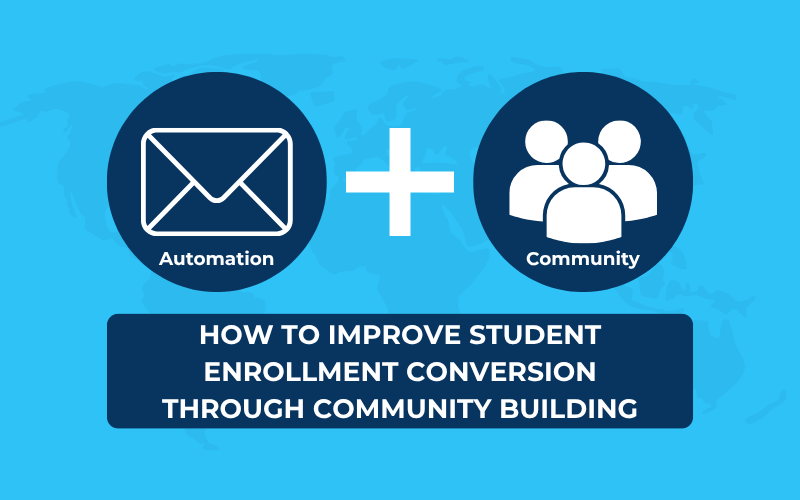
Automation can keep students moving through an enrollment funnel. But keeping a student informed is not the same as making them want to enroll. Institutions lose attention in this window not because students lack interest, but because the work of following up is manual, repetitive, and spread across disconnected tools. Conversion software exists to close that gap: it streamlines the funnel by automating the routine communications that staff would otherwise send by hand, while keeping every prospective student on a consistent, trackable path to enrollment.
The operational payoff is straightforward. Automation reduces manual workload for staff, letting a small enrollment team maintain contact with a large applicant pool without scaling headcount. Automated communication workflows ensure no admitted student is missed: acknowledgments, deadline reminders, next-step nudges, and handoffs fire at the right moment rather than when someone remembers to send them. The result is more consistent outreach and fewer prospects slipping out of the funnel simply because no one followed up in time.
Two evaluation criteria matter more than the feature list when choosing a tool.
Integration with your existing enrollment management CRM. Enrollment data already lives in your CRM, and a conversion tool that cannot talk to it creates a second, fragmented record of the same students. The strongest approach is a tool that centralizes student data by integrating with the systems you already run, so a prospect's communication history, engagement status, and enrollment stage live in one place rather than across siloed spreadsheets and inboxes.
Implementation effort and reporting. Ease of implementation determines whether the tool actually gets used. A platform staff can deploy and adopt without a heavy project is more likely to change behavior than one with a long rollout. Reporting matters for the same reason: automated communication is only useful if you can see what it did. Look for clear data reporting on outreach volume, response and conversion by stage, and where prospects drop off, so the tool improves decisions rather than just automating activity.
Enrollment management CRM solutions aim to "bring more of the right students into your funnel while reducing manual work for staff," and that is the working definition of conversion software for this stage: more targeted outreach, less manual effort, and a funnel that runs consistently regardless of staff bandwidth.
Student-led nurturing and community building
Automation handles scale, but it does not by itself create the connection that pushes an admitted student from "accepted" to "enrolled." That decision is emotional, and it is increasingly influenced by whether a student can picture themselves belonging on campus. Community-based conversion software addresses this by using student-to-student connections to nurture prospects and build that sense of belonging before day one.
The mechanism is peer influence. When a prospective student hears directly from current students about clubs, routines, housing, and campus culture, the information carries authenticity that templated institutional emails cannot replicate. Student ambassadors sit at the center of this approach: they provide real, peer-led nurturing from a perspective no automated campaign can match. Their answers are specific, unscripted, and credible precisely because they come from someone living the experience rather than marketing it.
This reflects a wider shift in the industry. With declining enrollment rates and increasing competition for student attention, colleges and universities are turning to specialized software platforms to foster meaningful connections, streamline event management, and create vibrant campus communities. Institutions are deliberately pairing operational enrollment tools with engagement platforms rather than treating a CRM as the whole answer.
The practical comparison is community-based conversion versus standard email-based nurturing:
- Email-based nurturing reaches a wide audience consistently and cheaply, but it is one-directional. It informs; it rarely persuades, because it does not let a prospect experience the community.
- Community scales student-to-student interaction that builds a sense of belonging that directly influences the enrollment decision. It converts because it answers the question no campaign email can: what will my life actually be like here?
Neither replaces the other. The most effective enrollment strategy combines automated funnel management with a peer-led layer that gives prospective students real conversations with the people they will be studying alongside.
This is where the role of conversion software broadens. It is not only an automation layer for staff; it is also a community-building platform that drives enrollment and retention by facilitating authentic student-to-student connections. Goin' is built on exactly that premise: a community-building software platform for higher education that connects students to one another to drive enrollment, retention, and onboarding, while keeping the effort low for staff. That combination, a manageable funnel for administrators and genuine peer connections for prospective students, is the pattern institutions are moving toward as they evaluate conversion software for the admission-to-enrollment window.
%20(1).png)
.png)
.svg)
.png)
.png)
%20(1).png)
.jpg)
.png)
.png)
.png)
%20(1).png)
.png)
.jpeg)
.png)
.jpg)
.png)
.png)
.png)

%20(1).png)
.png)
.png)
.jpg)
.png)
.png)
.png)
.jpg)
.png)
.png)
.svg%20(1).png)
.png)
.png)
%20(1).png)
.png)
.png)
%20(1).png)
.jpg)
%20(1).png)
%20(1).jpg)
%20(1).jpg)

.svg)
.png)
%20(1).png)
.png)
.jpg)
.svg)
.jpg)
.jpg)
.png)
%20(1).png)
.png)
.svg)
.jpg)
.png)

.png)

%20(1).png)
.png)
.png)
.png)
.png)
.png)


%20(2)%20(1).png)


.jpg)


.png)
.png)
.png)
.png)
.png)
.png)
