%20(1).png)

Student Software & Tools for Onboarding Higher Education
Onboarding hundreds or thousands of new students involves during their first year or exchange programs comes with much more than sending welcome emails and sharing practical information. Students are looking for answers, friendships, housing advice, events and reassurance about the experience ahead, often before they ever arrive on campus.
For university teams, supporting all of this can quickly become a significant workload.
Student onboarding software can help universities bring these different parts of the experience together. Instead of manually coordinating introductions, answering the same questions and managing every interaction, institutions can give students a space where they connect with each other and start building their own community.
The result is an onboarding process that requires less manual coordination from staff while helping students feel connected to their university before arrival.
Minimizing staff effort in student onboarding
Operational efficiency is one of the most important considerations when choosing a student onboarding platform. The technology should reduce administrative work rather than create another system for staff to manage.
Goin' is designed around a student-led community model. Universities invite their incoming students to join, after which students can discover and connect with peers based on their nationality, hometown, studies, interests and hobbies.
Students can then create their own groups, join conversations and ask each other questions without university staff having to coordinate every interaction.
More than 80,000 groups have been created by students across Goin' communities, allowing conversations and smaller communities to develop naturally around the topics students care about.
This also creates opportunities for peer-to-peer support. Questions about housing, transport, student life, courses and other practical topics can often be answered by fellow students rather than automatically becoming another question for university staff.
Instead of trying to manage every part of the community themselves, university teams can focus their time on the situations where their involvement is actually needed.
What automated student onboarding looks like
Automation does not mean removing the human element from onboarding. It means removing unnecessary manual work around the connections students are already looking to make.
A typical onboarding journey can be simple:
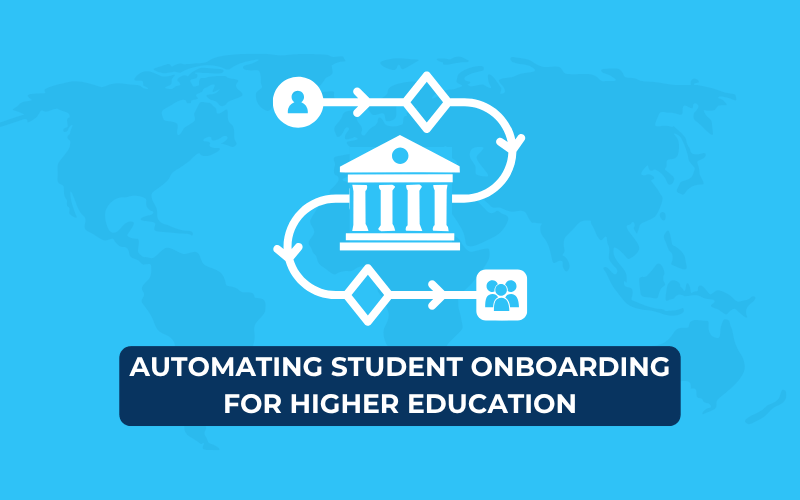
Invitation → Join the community → Discover relevant peers and groups → Ask questions → Join conversations → Build connections before arrival
Students choose what they are interested in and who they want to connect with, while the platform makes those connections easier to find.
This allows onboarding to scale across large cohorts without requiring staff to manually match students or create every group and conversation themselves.
It also shifts onboarding away from being purely transactional. Instead of only receiving information from the university, students become active participants in the community they are about to join.
Building belonging before students arrive
Student onboarding is also an opportunity to help students establish a sense of belonging before they begin their studies.
Starting university can mean moving to a new city or country without knowing anyone. Giving students access to their future community before arrival allows them to find classmates, meet people with similar interests and ask questions to others going through the same experience.
Goin' is built specifically around these student-to-student connections. Across more than 150 university partners, students have created millions of friendships and thousands of communities around programmes, nationalities, interests and everyday student life.
There are also signs that early community participation is associated with important student outcomes.
At Utrecht University, for example, students using Goin' had an observed dropout rate of 11%, compared with 21% across the wider university population. Among Bachelor's students, the figures were 20% and 29% respectively, while among Master's students they were 5% and 11%.
These figures do not by themselves establish that Goin' caused the difference. They do, however, show a relationship between participation in the student community and outcomes universities care about, making early student engagement worth measuring alongside traditional onboarding activities.
What to look for in a student platform for onboarding
When evaluating student software for onboarding, universities should look beyond the number of features available. The bigger question is whether the platform makes onboarding easier for staff while creating an experience students genuinely want to participate in.
Student-led communities. Students should be able to discover peers, start conversations and create groups around their own interests without relying on staff to coordinate every interaction.
A simple onboarding flow. Joining the community should require as little friction as possible. A straightforward invitation and registration process makes it easier to introduce the platform across large incoming cohorts.
Relevant peer connections. Students should be able to find people based on factors that actually matter to them, such as programme, nationality, hometown and shared interests.
Pre-arrival engagement. Community-building should begin before students arrive on campus. This gives incoming students time to ask questions, meet people and become familiar with their new university community.
Peer-to-peer support. Students will naturally have questions throughout the onboarding process. Giving them a place to help each other can provide faster answers while reducing repetitive questions directed at university teams.
Moderation and oversight. A student-led community should not mean leaving universities responsible for monitoring everything themselves. Clear moderation processes help keep communities safe and reduce the operational burden on staff.
Measurable engagement. Universities should be able to understand whether students are actually connecting, participating and engaging rather than relying solely on registrations or logins as measures of success.
Conclusion
Effective student onboarding is about more than completing administrative tasks before the first day of class. It is also the period when students begin forming their first impressions, asking important questions and finding their place within the university community.
Technology can remove much of the manual coordination involved in that process without removing the human connections that make onboarding valuable.
By giving students a space to meet peers, create their own communities and support each other before arrival, universities can build a more scalable onboarding experience while giving staff more time to focus on the students and situations that need their attention most.
%20(1).png)
.png)
.svg)
.png)
.png)
%20(1).png)
.jpg)
.png)
.png)
.png)
%20(1).png)
.png)
.jpeg)
.png)
.jpg)
.png)
.png)
.png)

%20(1).png)
.png)
.png)
.jpg)
.png)
.png)
.png)
.jpg)
.png)
.png)
.svg%20(1).png)
.png)
.png)
%20(1).png)
.png)
.png)
%20(1).png)
.jpg)
%20(1).png)
%20(1).jpg)
%20(1).jpg)

.svg)
.png)
%20(1).png)
.png)
.jpg)
.svg)
.jpg)
.jpg)
.png)
%20(1).png)
.png)
.svg)
.jpg)
.png)

.png)

%20(1).png)
.png)
.png)
.png)
.png)
.png)


%20(2)%20(1).png)


.jpg)


.png)
.png)
.png)
.png)
.png)
.png)
